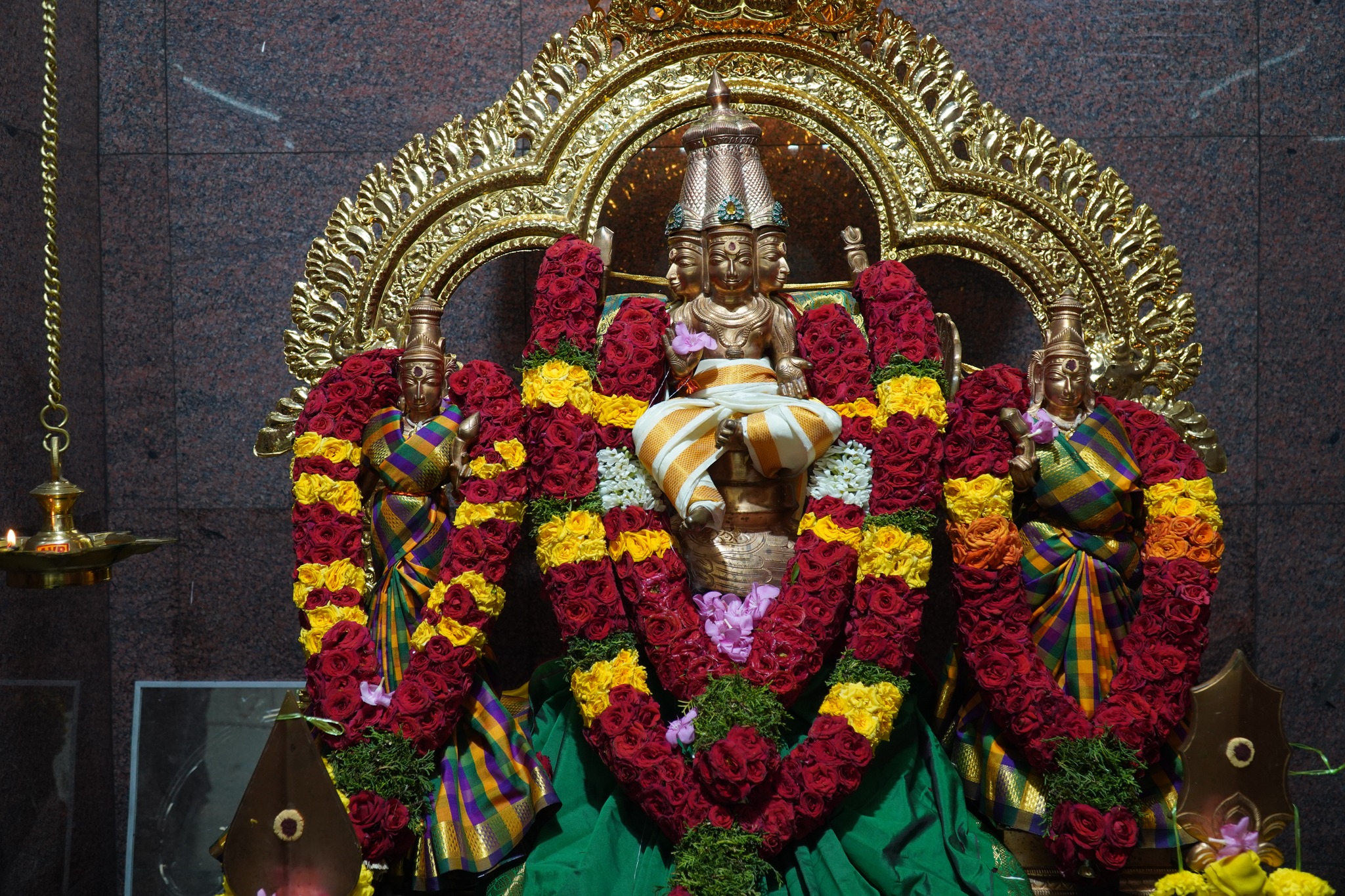
Under the alluring azure skies of Serdang, a serene spiritual destiny awaits to favourably alter your karmic destiny. The cosmic mother, Sivakaliamman is resplendent with benediction, guiding lamenting souls out of anguish and misfortune. Replacing a path of adversity, these tormented souls are guided to a fortuitous path of success, gaiety and contentment. As a cosmic mother, Sivakaliamman compassionately removes the karmic thorns that prick our bright souls. The karmic thorns that pierce and bleed us are extinguished, hence liberating our souls to a brighter path ahead. Her formidable existence is intricately tied to the persistent prayers of a humble devotee named Sivananthen. The humble beginnings of this temple is astounding. Established as shrine in a different location in Kajang, but was soon enforced to relocate. After moving to its current location, an injurious burglary inflicted upon the workers of the temple devastated the determination of Sivananthen. Gathering whatever left of his courage, he solemnly resolved to persevere through prayers for the sake of mother Sivakaliamman regardless the circumstance.

The cosmic mother's origin is deeply connected to the renowned Mariamman temple located at Jalan Tun H.S. Lee, Kuala Lumpur. A devout person by birth, Sivananthen often visited this Mariamman temple. After completing his prayers, he would stay back to perform any mundane task requested by the temple priests. During one such visit, he went back to his residence late at night and slept off peacefully. Just before the break of dawn, he had a vision of an elderly woman dressed in a lustrous saree and adorned in gleaming jewellery. The old lady blessed Sivananthen profoundly, and dotingly gave him a small baby girl wrapped in luxurious fabric. The old lady then endearingly informed Sivananthen to take care of the baby, emphasising this is his ultimate purpose in this world, and nothing else should take precedence.
After this vision, Sivananthen would often accompany many temple priests in performing the consecration ceremony at various Hindu temples around Malaysia. As such, he learnt the skill of Hindu prayers and rituals, singing devotional Tamil hymns and the art of divination using cowrie shells. As he was dedicated in his temple service, he would regularly be called upon to assist performing 'puja' (ritual worship) at important Hindu festivals and ceremonies. During such a visit, he was requested to participate in a grand 'puja' at the Sivakaliamman shrine in Kajang. As the prayers were intensely coming to a conclusion, the gathered Hindu priests feverishly chanted ancient Vedic verses, whilst fruits, grains and ghee were reverently offered into the sacrificial fire. As the ending of the ceremony reached a sacred pinnacle, a lady standing close to the 'homam kundam' (pit for performing fire rituals) started yelling in ancient Tamil, beckoning Sivananthen to come near to her. She then vividly informed Sivananthen that he was tasked to take care of the cosmic mother, Sivakaliamman. Muttering loudly, she further informed him that Goddess Mariamman had previously instructed Sivananthen in a dream.

Soon after, Sivananthen would come whenever possible to this temple, and participate in the temple's daily 'puja'. He was involved in the relocation of the temple, and eventually managed the temple with a group of dedicated devotees. One of the intriguing aspects of this temple is the monthly Pratyangira 'homam' (fire ritual) held on 'Amavasya' (new moon). Goddess Pratyangira is a fierce manifestation of cosmic mother, her divine presence essentially to shield against sorcery and destroy negative energy. Her formidable lioness face deters all forms of witchery that agonize her sincere devotees. As the Pratyangira 'homam' draws to an end, trays of dried chilli, fruits, grains, and spoons of ghee are offered into the sacrificial fire amidst reverberating chants of Pratyangira mantra. The offering of dried chilli is significant as it shatters and eradicates the adverse effects of negative energies. Devotees assemble by the hundreds to witness this remarkable spiritual gathering and partake the divine blessings that safeguard their family. Karmic curses that persecute devoted families are mitigated, and the goddess's blessings usher in radiant optimism and rejuvenated strength.

A woman was undergoing an agonizing predicament in her life. Three of her siblings had tragically passed away within a span of a few months. As soon as the funeral rites for one sibling was completed, another sibling departed the earthly existence. The last sibling to pass away was her youngest brother, overwhelming her with melancholy. The melancholy engulfed her and drowned her in excruciating sorrow. As she inherited her younger brother's vehicle, she drove it with the remaining nostalgic moments she shared with her younger brother. However soon after she continuously experienced unexpected vehicle accidents whenever she drove that car. Subsequently she started having trouble in her office, confronted with constant arguments with her workplace superiors. About the same time, she started experiencing stabbing pain in her shoulders. Although she visited the doctor, the diagnosis revealed nothing conclusive to determine the cause of the pain. The breaking point came when her spouse and her were started constantly bickering. The peace and harmony of their charming home was shattered, and they were habitually at each other's throat.

An affluent devotee of the temple felt anxious. He had just visited the Sivakaliamman temple in the evening and felt as though the cosmic mother was trying to convey a message of great significance. That same night, he had an intense vision of Goddess Sivakaliamman commanding the devotee to build a temple for Lord Shiva. She told him to start this spiritual task straight away without any delay. He immediately discussed this spiritual vision with Sivananthen and both decided to obtain the views of a head priest from the prominent Ekambaranathar temple at Kanchipuram. The head priest immediately suggested a location within the Serdang Sivakaliamman temple to build a shrine for the 'Shivalingam' (divine symbol of Lord Shiva). The building of the shrine was done immediately with great care and attention. A week before the completion of the shrine, Sivananthen had an unusual dream. In his dream, two grey haired men with long silvery beards and clad in snowy white robes met him at the temple. They asked Sivananthen if the shrine has been completed, and where the 'Shivalingam' was kept. Sivananthen then replied the shrine was going to be completed in a few days, and 'Shivalingam' was kept in the temple's office. They blessed Sivananthen and left in silence.
A few days before the consecration ceremony of 'Shivalingam', the affluent devotee was violently attacked by masked robbers. The robbers viciously attacked the devotee in his vehicle and then stole his opulent watch and then drove away frantically with his prestigious vehicle. As they used a machete to ambush the devotee, he was bloodied and bruised all over. Nearby pedestrians called the emergency line, and soon an ambulance rushed to the crime scene. Despite the grievous wounds on the devotee, he survived and requested his wife to inform Sivananthen on what had transpired. A worried Sivananthen who was shocked by this gory incident wanted to postpone the consecration ceremony. The devotee vehemently refused this suggestion and politely requested Sivananthen to continue the ceremony as planned. The consecration ceremony for the 'Shivalingam' was conducted magnificently as planned, attracting hundreds of faithful devotees to participate in this holy event. Despite the injuries, the affluent devotee cheerfully attended the event, thankful to have survived the bloody ordeal. Upon completion of the consecration ceremony, the priests who were in charge of the ceremony noticed there was a deep cut mark on the 'Shivalingam' as well as on the 'Nandhi vahana' (sacred vehicle for Lord Shiva). The cut marks were not visible previously, puzzling everyone at the temple. Sivananthen cryptically answered this could be due to blessings of Lord Shiva protecting his devotee during the armed robbery.
Many strange miracles have occurred in this temple, one of which is truly unfathomable. A recent CCTV recording displayed the manifestation of an energy orb moving around the shrine for Lord Shiva, bouncing in and around the shrine and finally fading away. A second energy orb is noticeable as well in the video, moving speedily all around the temple. Energy orbs principally signifies the presence of divine energy. Another interesting feature of this temple is a water well containing revitalising spring water. A 'Shivalingam' is kept at the bottom of the water well, and only taken out once a year for 'Mahashivaratri' (annual spiritual festival for Lord Shiva). The refreshing water taken out of the water well is used for the ritual bathing of the 'Shivalingam' during 'Pradosham puja' (bi-monthly worship of Lord Shiva to remove sins). Intriguingly, there is a mound of salt located behind the shrine for 'Karrupasamy' (guardian deity). Many dutiful followers bring packets of salt and scatter it in small amounts on the salt mound. The salt is believed to remove the impurities of the soul, hence a simple method to cleanse our spiritual embodiment. This temple has a massive number of devotees, each devotee has truly felt the cosmic power of Sivakaliamman, drawn towards the ethereal divinity that pervades throughout the temple. Each devotee has gained spiritually and benefited in a materialistic sense that nourishes and provides for their family.


.jpg)


.jpeg)